
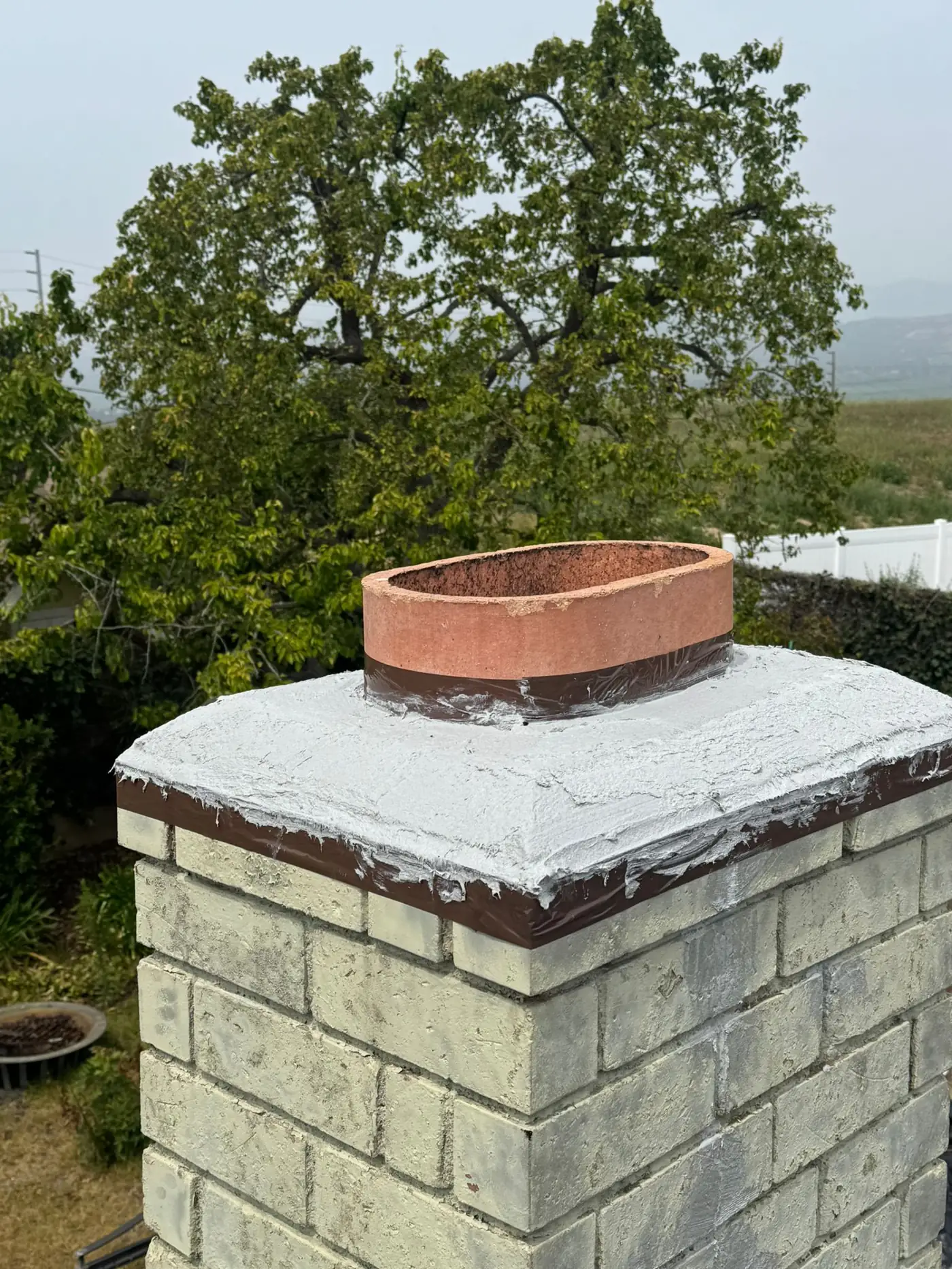
Chimney Waterproofing
A vapor-permeable, siloxane-based repellent applied after any needed repairs are complete — blocking liquid water from soaking into your masonry while still letting internal moisture escape, so brick, mortar, and the crown stay protected without trapping damage inside.
- Sealant onlyFrom $150
- Bundled w/ repairsFrom $300
- ReapplicationEvery 5–10 years
- Product typeSiloxane / Silane
Water Is Chimney Enemy #1
Masonry looks solid, but it's porous. Water enters through hairline cracks, degraded mortar joints, a failing crown, or missing and improperly sealed flashing — and once it's inside, it doesn't just sit there. It causes spalling, where the face of the brick pops off from freeze-thaw or repeated wet-dry cycling; it corrodes metal components like the damper, liner connectors, and wall ties; it rots wood chase framing and roof decking behind the chimney; it promotes mold and mildew inside wall cavities; and eventually it breaks down mortar joints from the inside, accelerating the exact structural failure that tuckpointing and masonry repair exist to fix.
CSIA and virtually every masonry trade body cite water as the single most common cause of chimney deterioration — more common than fire damage, and more common than simple age. That's the whole reason waterproofing exists as a standalone service: it's cheaper and far less disruptive to keep water out in the first place than to repair the damage it causes once it's inside the masonry.
Not every waterproofing product does this correctly, though, and that's the detail most competitors skip over when they advertise "we waterproof chimneys." The product and application method matter as much as the decision to waterproof at all.
Why Product Choice Is the Whole Game: Vapor-Permeable vs. Sealed
The industry-standard sequence is always repair, then seal. Waterproofing over existing cracks or a damaged crown traps moisture already inside the masonry — making the problem worse, not better.
The product must block liquid water from entering while still letting water vapor escape from inside the masonry. A non-breathable sealant, like plain silicone caulk or oil-based paint, traps internal moisture and causes worse damage than no treatment at all.
CSIA-endorsed product categories like ChimneySaver-type siloxane and silane formulas are the industry standard specifically because they achieve this breathable-but-repellent balance.
We apply two coats via low-pressure sprayer for even saturation, with proper flash time between coats, treating the crown and all four masonry sides plus roof-adjacent flashing.
Our Process
Every waterproofing job starts with a full masonry inspection, not a sprayer. We're checking for cracks, crown condition, flashing integrity, and mortar joint condition first, because sealing over existing damage is the single most common mistake in DIY and low-quality waterproofing jobs. If we find issues, we'll recommend addressing them — whether that's crown repair or mortar repointing — before applying any sealant.
Once the masonry is sound, we clean the surface by pressure washing and brushing at low PSI (roughly 1,000–1,500) to remove dirt and efflorescence without damaging old or soft mortar, since high-pressure washing can do more harm than the water intrusion we're trying to prevent. We let the masonry dry fully — typically 24 to 48 hours, weather dependent — before applying anything, since sealing over damp brick traps that moisture underneath the new coating.
The repellent itself goes on in two coats using a low-pressure pump sprayer, never a high-pressure unit, which would force product too deep or waste material through overspray. We treat the crown, all four masonry sides, and extend slightly onto roof-adjacent flashing, since water intrusion at the flashing line is one of the most common — and most missed — entry points on a residential chimney.
Standards We Follow
No building code mandates chimney waterproofing — it's preventive maintenance, not a required inspection item. But CSIA publishes consumer guidance specifically warning that not all "waterproofing" products are equal, and that vapor-permeable formulation is required for a product to actually protect masonry rather than damage it long-term. Most competitor sites just say "we waterproof your chimney" without explaining why the product matters — we think that's a disservice to homeowners making a $150–$800 decision, so we explain the repair-first sequencing and vapor-permeability requirement on every estimate.
Signs Waterproofing Is Needed or Overdue
- • Efflorescence — white, chalky mineral deposits on the brick face
- • Visible dampness or dark discoloration on the brick after rain
- • Spalling — brick faces popping or flaking off
- • Rusted damper or firebox metal
- • A musty odor or moisture inside the firebox or smoke shelf
- • More than 8–10 years since the last treatment (repellents are rated roughly 5–10 years)
Why It Matters More Here: Temecula's Sun & SoCal's Seismic Risk
Temecula's intense UV exposure is a bigger factor in sealant lifespan than most homeowners expect. A south- or west-facing chimney under direct Southern California sun for most of the day degrades sealant faster through UV breakdown than a shaded, north-facing one — meaning the "5 to 10 years" reapplication window skews toward the shorter end for a lot of local roofs, not the longer end. We factor sun exposure into the reapplication timeline we recommend rather than quoting a flat number that doesn't reflect your specific roof.
There's a structural angle too. Riverside and Orange County sit within active Southern California seismic zones tied to the San Jacinto, Elsinore, and broader San Andreas fault systems, and unreinforced masonry chimneys — common in homes built before modern seismic bracing became standard — are among the most seismically vulnerable parts of a house. Water intrusion accelerates exactly the kind of mortar and brick deterioration that makes a chimney more likely to crack or shift during ground movement, so keeping water out isn't just a cosmetic maintenance item here — it's part of what keeps the masonry sound enough to handle minor shaking without damage.
Materials We Use — and What to Avoid
We apply siloxane and silane-based water repellents, the same category endorsed across the CSIA-informed consumer guidance we build our process around. These formulas penetrate into the masonry itself rather than sitting on top of it as a film, which is part of how they stay breathable — water vapor generated inside the brick from normal humidity and temperature changes can still pass through the treated surface and evaporate, while liquid water beads up and runs off the outside.
What we won't use, and what we'd caution any homeowner against buying off a shelf, is plain silicone caulk smeared over crown cracks, or an oil-based paint sealer applied to brick. Both create a film-forming, non-breathable barrier. On a chimney, that's a serious problem: any moisture already present inside the masonry — from a prior rainy season, condensation, or a not-yet-repaired crack — gets sealed in rather than let out. Over a hot Temecula summer, that trapped moisture expands and contracts against the inside of the brick face, which is a documented cause of accelerated spalling. It's a case where the wrong "protective" product does more damage than doing nothing at all.
Application equipment matters just as much as the product. We use low-pressure pump sprayers calibrated for even saturation rather than high-pressure sprayers, which force product too deep into some areas while leaving others under-covered through overspray and runoff. For pre-cleaning, our pressure washers are dialed to roughly 1,000–1,500 PSI — high enough to lift dirt and efflorescence, low enough that we're not blasting soft or already-deteriorated mortar out of the joints in the process.
DIY Waterproofing vs. Hiring a Professional
Homeowner-grade siloxane sealants are sold at most hardware stores for $20–$60 a gallon, and for a small, easily-accessible single-story chimney in good repair, a careful DIY application can work reasonably well. Where DIY runs into trouble is everywhere the inspection step matters: without professionally checking for cracks, crown failure, or deteriorated mortar first, it's easy to seal over a problem rather than in front of one — and once that happens, the trapped moisture issue described above starts working against you instead of for you.
Coverage consistency is the other common DIY miss. Uneven application — heavier in some spots, thin or missed entirely in others (especially on a steep roof pitch where full access is genuinely difficult without fall protection) — leaves gaps where water can still get in while the surrounding treated area looks fully protected. A professional 2-coat application with a calibrated low-pressure sprayer is built specifically to avoid that unevenness, and because we inspect first, we can tell you honestly if your chimney needs repair work before waterproofing rather than after you've already paid for a sealant that's now trapping damage inside.
Waterproofing Cost in Temecula
Sealant application alone typically runs $150–$500. Bundling crown or flashing repair with a full 2-coat application runs $300–$800. DIY materials cost $20–$60 per gallon and cover roughly 90–100 square feet, but professional application is strongly recommended — the wrong product or uneven coverage traps moisture and accelerates the exact damage waterproofing is meant to prevent. Pricing depends mainly on chimney height, roof pitch and access, total masonry surface area, and whether any crown or mortar repair needs to happen first. We always inspect before quoting so the number you get reflects the actual condition of your chimney, not a generic flat rate. For a full breakdown of pricing across every chimney service, see our complete chimney service cost guide.
Frequently Asked Questions
Why is water considered the biggest threat to a chimney?+
Masonry is porous, so water enters through cracks, degraded mortar, a failing crown, or missing flashing, causing spalling, metal corrosion, wood rot, mold, and eventual structural joint failure. CSIA cites water as the most common cause of chimney deterioration.
What's the difference between vapor-permeable and regular sealant?+
Vapor-permeable repellent blocks liquid water while letting vapor escape from inside the masonry. A non-breathable sealant like silicone caulk traps internal moisture and causes worse damage. Siloxane/silane formulas are the industry standard for this reason.
Should repairs be done before or after waterproofing?+
Always before. Sealing over existing cracks or crown damage traps moisture already inside the masonry, which accelerates damage rather than preventing it. A full inspection always precedes waterproofing.
How often does chimney waterproofing need to be reapplied?+
Most repellents are rated 5–10 years, but chimneys facing intense sun degrade faster via UV breakdown. Temecula's high UV exposure often means south/west-facing chimneys need reapplication closer to 5 years.
Can I waterproof my chimney myself?+
DIY products are available, but professional application is recommended since the wrong product or uneven coverage can trap moisture and accelerate damage rather than prevent it.
How much does chimney waterproofing cost in Temecula?+
Sealant alone runs $150–$500; bundled with crown/flashing repair, $300–$800. See our cost guide for a full breakdown.
Related Services
Ready to Protect Your Chimney From Water?
Free written estimates for Temecula, Murrieta, Menifee, Wildomar, Winchester, French Valley and Orange County.