
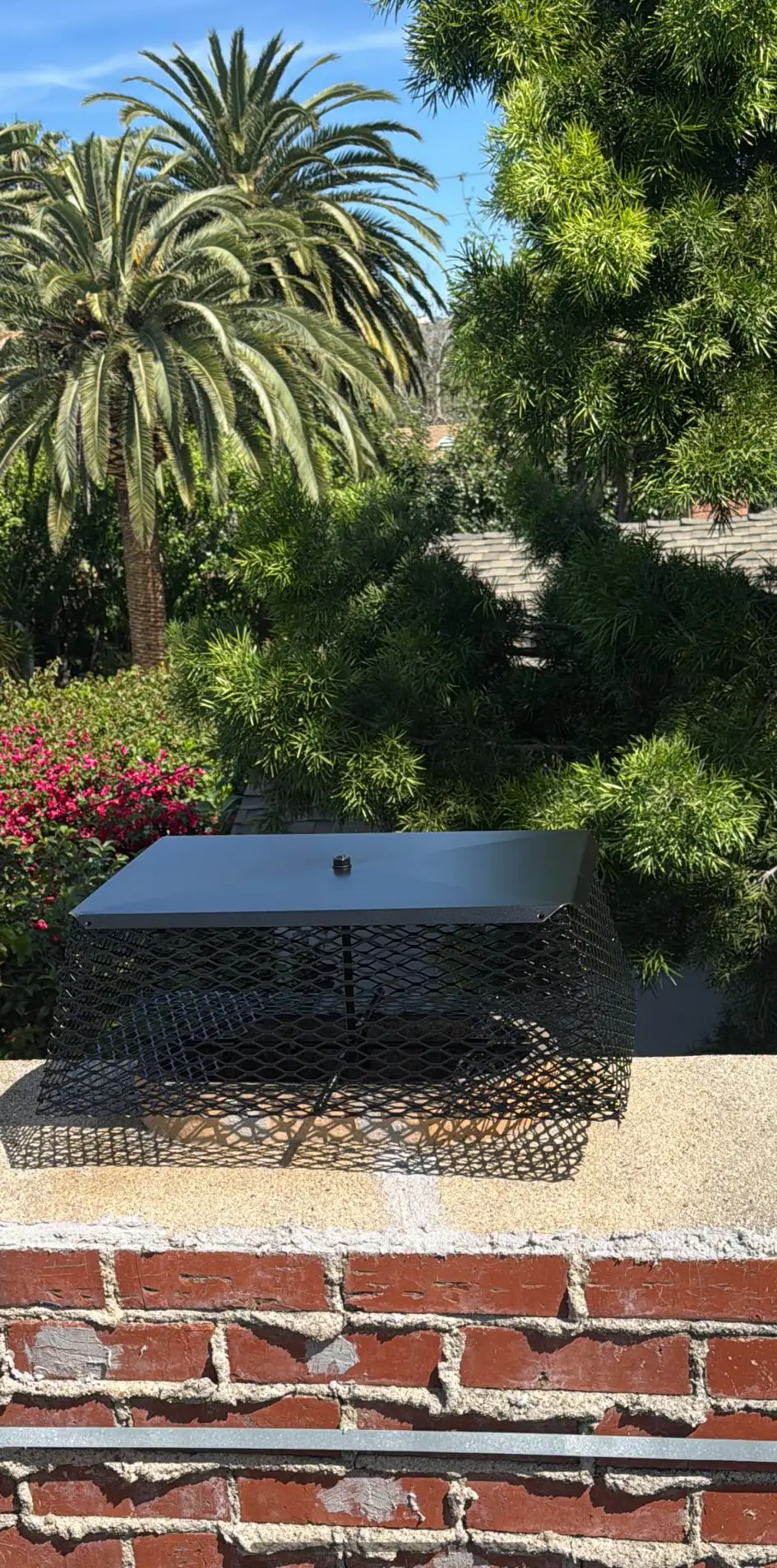
Chimney Cap & Spark Arrestor Installation
Precision-fit rain caps and spark-arrestor mesh that stop water, embers, and animals at the flue opening — sized to your exact flue, matched to a mesh spec that meets local fire code, and installed on every flue you have, not just the easiest one to reach.
- Typical costFrom $190
- Install time30–90 min
- Stainless cap lifespan15–20+ yrs
- StandardNFPA 211 / CA Fire Code
What Chimney Cap Installation Involves
A chimney cap is the removable metal cover that sits directly above the crown, mounted over the flue opening itself — not to be confused with the crown, which is the concrete or mortar slab it sits on. A properly built cap does two jobs at once: a solid metal top keeps rain out, and mesh screening around the sides, typically 3/4 inch or smaller stainless or galvanized wire, keeps sparks and embers from landing on your roof while blocking birds, raccoons, and debris from getting into the flue. We start every job by measuring each flue opening individually, since round, square, and rectangular flues all require different cap geometry, and a multi-flue chimney frequently has openings that aren't identical sizes even when they look the same from the ground.
Once we know the exact dimensions, we determine whether the chimney needs an outside-mount cap, which fits over the crown and flue like a lid, or an inside-mount cap, which fits down inside the flue tile itself and holds with internal tension or a clamp mechanism — the right choice depends on the flue's construction and condition. For chimneys with two or three flues close together, we'll walk you through the tradeoff between installing individual caps on each flue versus a single band-around cap that covers the entire crown top in one piece; band-around designs look cleaner and simplify future maintenance, but they cost more upfront and make it slightly harder to service one flue without disturbing the others.
Installation itself is straightforward once the cap is correctly sized: outside-mount caps are secured with stainless steel screws or bolts driven into the flue tile or surrounding masonry, while inside-mount caps rely on spring tension or an internal clamp against the flue tile walls. Either way, we check the finished mesh spacing against local fire-code requirements before we leave the roof, and we confirm the cap isn't mounted so low that it restricts draft — an undersized cap or overly fine mesh is one of the more common causes of a fireplace that suddenly stops drawing well after a "repair."
Cap vs. Crown: Two Different Parts, Two Different Failures
The sloped concrete or mortar slab that seals the top of the masonry chimney around the flue. It's structural, poured in place, and fails through cracking, spalling, or poor slope pooling water.
A separate, removable metal cover mounted above the crown, over the flue itself. It's a hardware component, not structural, and fails through rust, bent mesh, or simply being missing entirely.
A chimney can have a failed crown and a perfectly good cap, or the reverse. We check both independently — quoting crown work when the real problem is a $250 missing cap (or vice versa) wastes your money either way.
Standards We Follow: NFPA 211 & California Fire Code
NFPA 211 requires a spark arrestor on chimneys serving solid-fuel appliances in most jurisdictions, commonly referencing mesh openings no larger than 5/8 to 3/4 inch. In California, that baseline gets tightened by state fire code and local wildland-urban-interface ordinances layered on top. Riverside County and many inland Southern California fire authorities require an approved spark arrestor with mesh sized to their specific local rule — we confirm the exact requirement for your address before we install, rather than assuming the national default mesh size is automatically compliant where you live.
We also size mesh to avoid the opposite problem: screening that's too fine restricts airflow and chokes draft, especially once it starts collecting fine creosote flakes between sweeps. Getting the spec right the first time means you meet code without creating a new draft problem six months later.
Signs You Need a New or Repaired Cap
- • No cap present at all — surprisingly common on older homes that were never retrofitted
- • Rusted-through or visibly bent mesh screening on the sides of the cap
- • Animal noises, scratching, or nesting debris found in the fireplace or smoke chamber
- • Water intrusion or staining even though the crown itself looks sound
- • A cap that's visibly crushed, dented, or missing after a windstorm
- • Multi-flue chimney where only some flues are capped
Why a Working Cap Matters More in SoCal During Fall
Most chimney sites talk about caps purely in terms of keeping rain and squirrels out, which is true but misses the sharper local risk. Temecula and inland Riverside County sit in Santa Ana wind territory, and the same fall-through-early-winter stretch that brings the driest, hottest offshore winds of the year is also exactly when homeowners start lighting fires again after months of disuse. A missing cap or blown-open, damaged mesh screen on a chimney that's actively burning during a red-flag wind event is a genuine ember-ignition risk, not just a theoretical one — sparks that would normally be caught by intact mesh can escape directly onto a roof or into dry landscaping during exactly the conditions Southern California fire authorities warn about most.
That's a meaningfully different reason to prioritize a cap inspection than "keeps leaves out," and it's why we check spark-arrestor condition specifically, not just generically, on every service call in Temecula, Murrieta, Wildomar, and the surrounding wildland-urban-interface communities — especially heading into wind season.
Choosing Cap Material: Stainless, Galvanized, or Copper
Stainless steel is the standard recommendation for long-term durability, with 316-grade offering better corrosion resistance than 304 in humid or coastal-influenced air, relevant for homes closer to the Orange County side of our service area. A quality stainless cap typically lasts 15 to 20 years or more with basically no maintenance beyond periodic mesh clearing. Galvanized steel costs less upfront but the protective coating wears through over time, and once that happens the underlying steel rusts — most galvanized caps need replacement within 5 to 10 years, which can make stainless the better value even though it costs more on day one. Copper sits at the premium end: it ages to a natural patina, resists corrosion extremely well, and often outlasts the roof it's mounted on, but it costs noticeably more than steel options and is usually chosen for aesthetic reasons on visible, higher-end chimneys.
We always use stainless fasteners regardless of cap material, since mixing dissimilar metals — say, a steel screw into a copper cap — creates galvanic corrosion at the contact point that can loosen the mount years before the cap itself would otherwise fail.
DIY Cap Installation vs. Hiring a Professional
Pre-made caps are sold at hardware stores and it's technically possible to bolt one on yourself if you're comfortable on a roof. Where DIY installs commonly go wrong is sizing and mounting: a cap that's slightly undersized for the flue leaves gaps that defeat the whole purpose, while one mounted too tight or too low can restrict draft in ways that aren't obvious until the next time you build a fire and the room fills with smoke. Multi-flue chimneys make this worse, since store-bought caps are usually made for a single standard opening and rarely fit a second or third flue of a different size without modification.
We also catch problems a homeowner installing a cap alone would likely miss — a crown that's already cracked under where the new cap will sit, mesh spacing that doesn't actually meet the local fire-code requirement for your specific address, or fasteners that will corrode against the cap material within a year or two. Because we're already on the roof, we check the crown, flashing, and mortar joints at the same time, so a cap job doesn't turn into a callback three months later for a problem that was visible the whole time.
Booking Your Cap Installation With Royalty Chimney
Call (951) 648-2583 or request a free estimate through this page, and let us know how many flues you have and whether you've noticed water intrusion, animal activity, or a missing cap already. We serve Temecula, Murrieta, Wildomar, Menifee, Winchester, French Valley, and Orange County, and because we're open 24/7 we can typically schedule a same-week visit. Every installation comes with a written summary of the material used, the mesh spec confirmed for your jurisdiction, and photos of the finished work — so you have a record on hand if you ever need to reference it for an inspection, insurance question, or home sale.
Not Sure If It's the Cap or the Crown?
Water stains and drafts can point to either part, and they're diagnosed and repaired differently. Learn about our chimney crown repair service, or just call — we'll tell you which one it actually is before quoting anything.
Chimney Cap Installation Cost in Temecula
A standard single-flue cap replacement on an easy-access roof typically runs $190–$650 installed. Multi-flue band-around caps, premium copper materials, or steep-pitch and multi-story tile roofs common across Temecula and Orange County can push the price to $375–$2,500 or more, largely driven by the added access and labor time. The biggest cost factors are how many flues need coverage, the material you choose, roof height and pitch, and whether an old, corroded cap needs to be removed and disposed of first.
For a full breakdown of every chimney service and what drives price up or down, see our complete chimney service cost guide.
Frequently Asked Questions
What's the difference between a chimney cap and a chimney crown?+
The crown is the sloped concrete slab sealing the chimney top around the flue. The cap is the separate removable metal cover above it, over the flue opening. They fail independently and are repaired separately.
Do I need a cap on every flue if I have more than one?+
Yes — each flue needs its own protection, either individual caps or one multi-flue band-around cap covering all openings. An uncapped flue is just as exposed as it would be on a single-flue chimney.
What size mesh does my spark arrestor need?+
NFPA 211 commonly references 5/8–3/4 inch mesh, but many Riverside County wildland-urban-interface areas require tighter mesh under local fire-authority rules. We confirm your exact local spec before installing.
How long does a stainless steel chimney cap last?+
Typically 15–20+ years for quality 304 or 316-grade stainless. Galvanized caps often need replacement within 5–10 years as the coating wears through and rust sets in.
Why is my chimney letting in water if the crown looks fine?+
A missing or failed cap is a common cause of water intrusion even with a sound crown, since rain falls straight down an open flue. We check the cap first — it's often the simpler, cheaper fix.
How much does a new chimney cap cost in Temecula?+
Typically $190–$650 for a standard single-flue replacement, up to $375–$2,500+ for multi-flue or premium materials. See our cost guide for a full breakdown.
Related Services
Ready to Protect Your Flue With a New Cap?
Free written estimates for Temecula, Murrieta, Menifee, Wildomar, Winchester, French Valley and Orange County.