
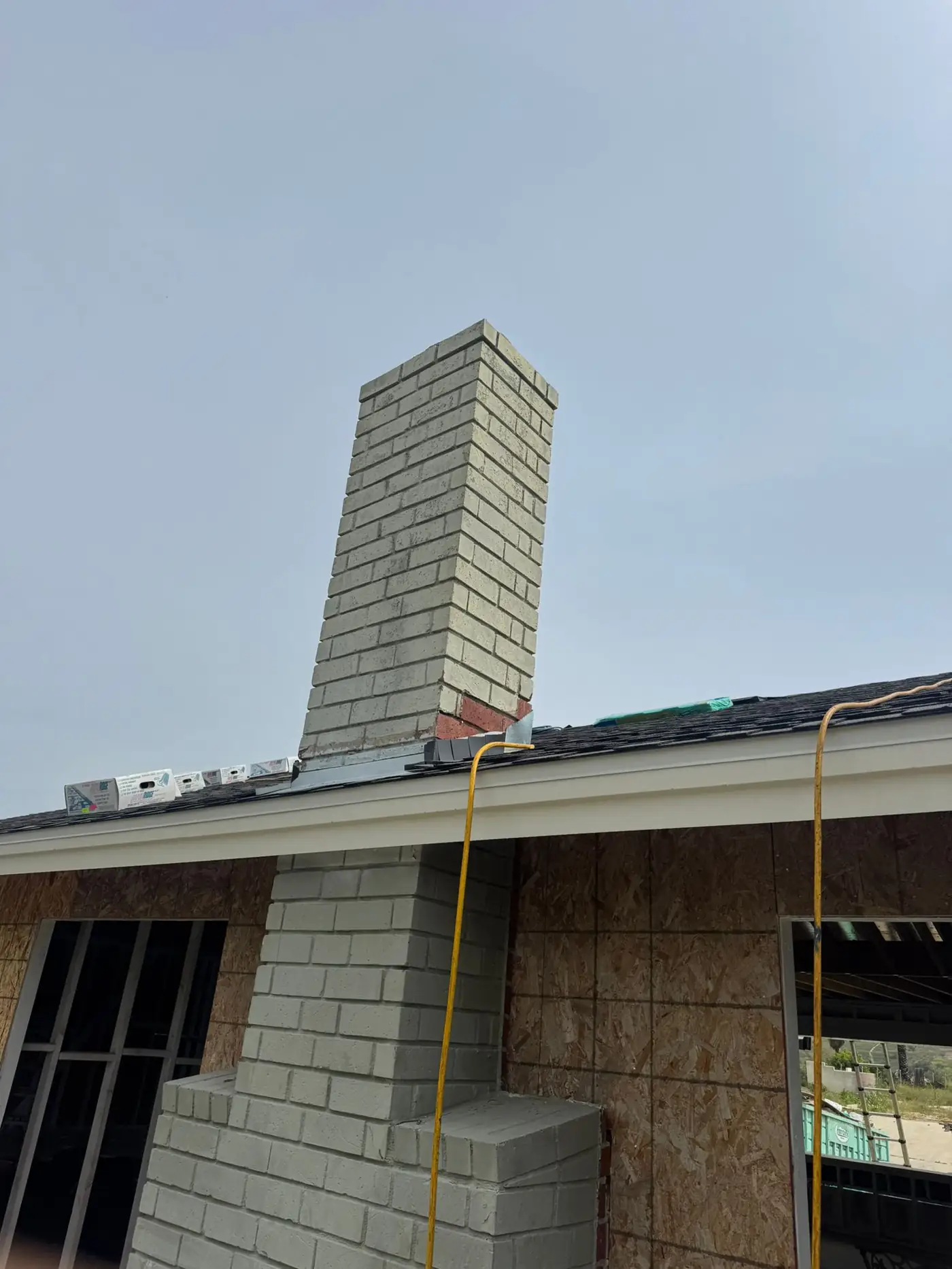
Full Chimney Rebuilding
When repairs can't keep up with structural damage, we rebuild the stack above the roofline from sound masonry up — new liner, crown, and flashing, with steel seismic anchoring added to bring older chimneys up to current standards, all pulled under proper permit.
- Typical costFrom $1,000
- Per linear footFrom $100
- Rebuild lifespan50+ yrs
- StandardNFPA 211 / CA Bldg Code
What a Chimney Rebuild Involves
A rebuild starts with a Level 2 or Level 3 inspection to define exactly how much of the structure is compromised — the single most important step, since it determines whether the job stays above the roofline, which is by far the most common scope, or requires opening the roof and interior chase, which is a far more invasive and costly undertaking. Once scope is confirmed, we set up scaffolding with proper fall protection; ladder-only access is rarely sufficient for a rebuild given the demolition and material handling involved. We then demo the damaged section down to sound masonry, working carefully to avoid damaging the roof, flashing, or the undamaged lower courses we're building back up from.
Because the structure is already open, a rebuild is the lowest-cost opportunity to inspect and replace the flue liner at the same time — we treat this as standard practice rather than an upsell, since doing it later means opening the chimney back up a second time. We rebuild course by course with new brick, matched to the existing material where that's a priority or a reasonably different match where sourcing an exact match isn't practical, using fresh mortar and maintaining the correct wall thickness and flue clearances to combustibles required under NFPA 211.
The crown gets rebuilt to proper specifications — correct overhang, slope, drip edge, and a bond break between the crown and the flue — which is often an upgrade over how the original was built, not just a replacement. We re-flash the chimney-to-roof intersection completely with new step and counter-flashing rather than reusing old flashing, since it's fully exposed at this point anyway and reusing it would be a false economy. A new cap goes on, water-repellent sealant is applied once the new masonry cures, and we close out with final inspection and permit sign-off where applicable.
Repair or Rebuild? The Decision Framework
When cumulative repair estimates climb past roughly 30–50% of a full rebuild's cost, rebuilding usually becomes the more sensible long-term investment rather than layering repair on top of repair.
A visible lean, tilt, or a widening gap where the chimney meets the house — a classic post-seismic-event finding locally — signals a structural problem repairs can't safely resolve.
Spalling across many bricks rather than a few isolated units, or a failing crown combined with several courses below it, points to a structure that's failing as a whole, not in one spot.
Standards We Follow: Permits, Seismic Code & NFPA 211
A full chimney rebuild is structural work — it involves demolition and reconstruction of a structural element of your home, which means it typically requires a building permit from the local jurisdiction, whether that's the City of Temecula, Riverside County, or the relevant Orange County municipality. We pull those permits as part of the job. If a contractor offers to skip that step to save time, that's a red flag worth taking seriously, not a convenience.
California Building Code seismic provisions apply to this kind of structural work, and in many CA jurisdictions a rebuild is treated as a genuine opportunity — sometimes a requirement — to bring an old unreinforced masonry chimney up to current seismic bracing and anchoring standards, using steel strapping that ties the chimney back to the roof structure, even though the original construction wasn't required to have it. That upgrade alone is one of the most valuable things a rebuild accomplishes in our region, and we include it as standard on rebuild projects rather than pricing it as an optional add-on. NFPA 211 continues to govern the flue sizing, clearances, and liner requirements for the rebuilt structure, same as it would for any chimney.
Signs It's Rebuild Time, Not Repair Time
- • Visible lean or tilt in the chimney stack
- • A widening crack or gap where the chimney meets the exterior wall of the house
- • Multiple bricks failing across most of the visible face rather than a localized patch
- • Repeated repairs to the same area within a few years, signaling the underlying cause was never actually fixed
- • A chimney that visibly shifted or cracked after an earthquake
- • Fire-damaged structure where mortar has lost integrity throughout, not just in one course
Why Seismic Anchoring Matters for Temecula & Orange County Homes
Riverside County and Orange County sit within active Southern California seismic zones tied to the San Jacinto, Elsinore, and broader San Andreas fault system. Masonry chimneys — especially unreinforced masonry chimneys common in homes built before modern seismic bracing became standard practice, roughly the pre-1990s stock built before post-Northridge code awareness reshaped residential construction — are among the most seismically vulnerable parts of a house. A rebuild is the natural moment to fix that, because the structure is already open and the cost of adding steel anchor strapping tying the chimney back to the roof framing is marginal compared to the cost of the rebuild itself.
Inland Riverside County and the wildland-urban-interface communities around Temecula also carry meaningful wildfire risk during Santa Ana wind events, which is part of why we always rebuild the crown and cap to current spec rather than reusing old components that may already have marginal spark-arrestor performance. A rebuild done right addresses both risks — structural and fire — in the same project rather than treating them separately.
What to Expect During the Project
Most above-roofline rebuilds take between two and five working days depending on total height, flue count, and weather, with scaffolding staying up for the full duration rather than being set up and torn down repeatedly. We sequence the work so your roof isn't left exposed overnight during demolition — temporary weatherproofing goes up at the end of each work day if the job spans more than one, which matters in a region where an unexpected rain event, however rare, can otherwise cause real interior damage through an open chimney chase.
You'll get a walkthrough of the finished structure before we break down scaffolding, including the new seismic strapping, the corrected crown geometry, and the re-flashed roof intersection, so you can see exactly what changed and why. We also provide photos documenting the completed work, useful both for your own records and, if you're planning to sell the home down the line, as proof that a major structural component was rebuilt to current code rather than patched.
Booking a Rebuild Assessment With Royalty Chimney
Call (951) 648-2583 or request a free estimate through this page, and describe what you're seeing — a lean, a gap at the roofline, cracked or spalling brick, or damage after a storm or seismic event. We serve Temecula, Murrieta, Wildomar, Menifee, Winchester, French Valley, and Orange County, and because we're open 24/7 we can typically schedule an inspection within days, sooner if the damage looks urgent. Every rebuild quote includes a clear explanation of scope, whether permits are required for your jurisdiction, and what's included — liner, crown, flashing, cap, and seismic anchoring — so there are no surprise add-ons once scaffolding is up.
Not Sure If Your Damage Needs a Full Rebuild?
Isolated brick or mortar damage is often fixable without a full rebuild. Learn about our masonry repair and tuckpointing services, or call us for an honest assessment — we'll tell you if a repair will genuinely hold before recommending anything bigger.
Materials We Use
Rebuilds go back together with new brick, matched to the existing home where that's a priority or a reasonably close alternative where exact sourcing isn't practical, and Type N or Type S mortar selected based on the structural demands and exposure of your specific chimney. The new liner is typically a stainless reline bundled into the project since access is already open, though cast-in-place is also common where the surrounding masonry needs reinforcement. Flashing is sheet copper or aluminum depending on your roofing material, seismic tie-back uses steel anchor straps and bracing rated for the connection to your roof structure, and every rebuild finishes with a new crown and cap built to current spec rather than salvaged from the old structure.
Chimney Rebuild Cost in Temecula
Rebuilding the stack above the roofline typically runs $1,000–$3,500 for smaller, simpler jobs, or $3,000–$15,000 for comprehensive full-height rebuilds, depending on total height, flue count, and finish. Partial above-roofline rebuilds generally fall in the $1,500–$8,000 range, and pricing per linear foot from roofline to crown typically runs $100–$300. If damage extends below the roofline into the interior structure, costs climb well beyond these figures given the added scope. Key cost drivers include total height rebuilt, number of flues, how difficult the brick or material match is to source, scaffolding requirements, whether seismic anchoring is added, roof pitch and tile-roof re-flashing complexity — common and often costly on Temecula and Orange County homes — and permit costs.
For a full breakdown of every chimney service and what drives price up or down, see our complete chimney service cost guide.
Frequently Asked Questions
How do I know if I need a rebuild instead of a repair?+
Rebuild usually makes sense when repair costs exceed roughly 30–50% of a full rebuild, when there's structural leaning or a widening gap at the house, widespread spalling, or repeated repairs to the same area that never fixed the underlying cause.
Does a chimney rebuild require a permit?+
Yes, in most cases, since it's structural demolition and reconstruction. We pull the required permits as standard practice on every rebuild.
Will my rebuilt chimney be seismically braced?+
Yes — we include steel anchor strapping tying the chimney to the roof structure, bringing older unreinforced masonry chimneys up to current seismic standards as part of the rebuild.
Does a rebuild include a new liner and crown?+
Typically yes — since the structure is already open, it's the lowest-cost time to replace the liner and rebuild the crown to correct spec, standard on our rebuild projects.
Does the whole chimney need to be torn down for a rebuild?+
Not usually. Most rebuilds are above the roofline only, demolished down to sound masonry. Below-roofline rebuilds into the interior chase are far less common and more invasive.
How much does a chimney rebuild cost in Temecula?+
Typically $1,000–$3,500 for smaller jobs or $3,000–$15,000 for comprehensive full-height rebuilds. See our cost guide for a full breakdown.
Related Services
Ready for a Structural Assessment?
Free written estimates for Temecula, Murrieta, Menifee, Wildomar, Winchester, French Valley and Orange County.