
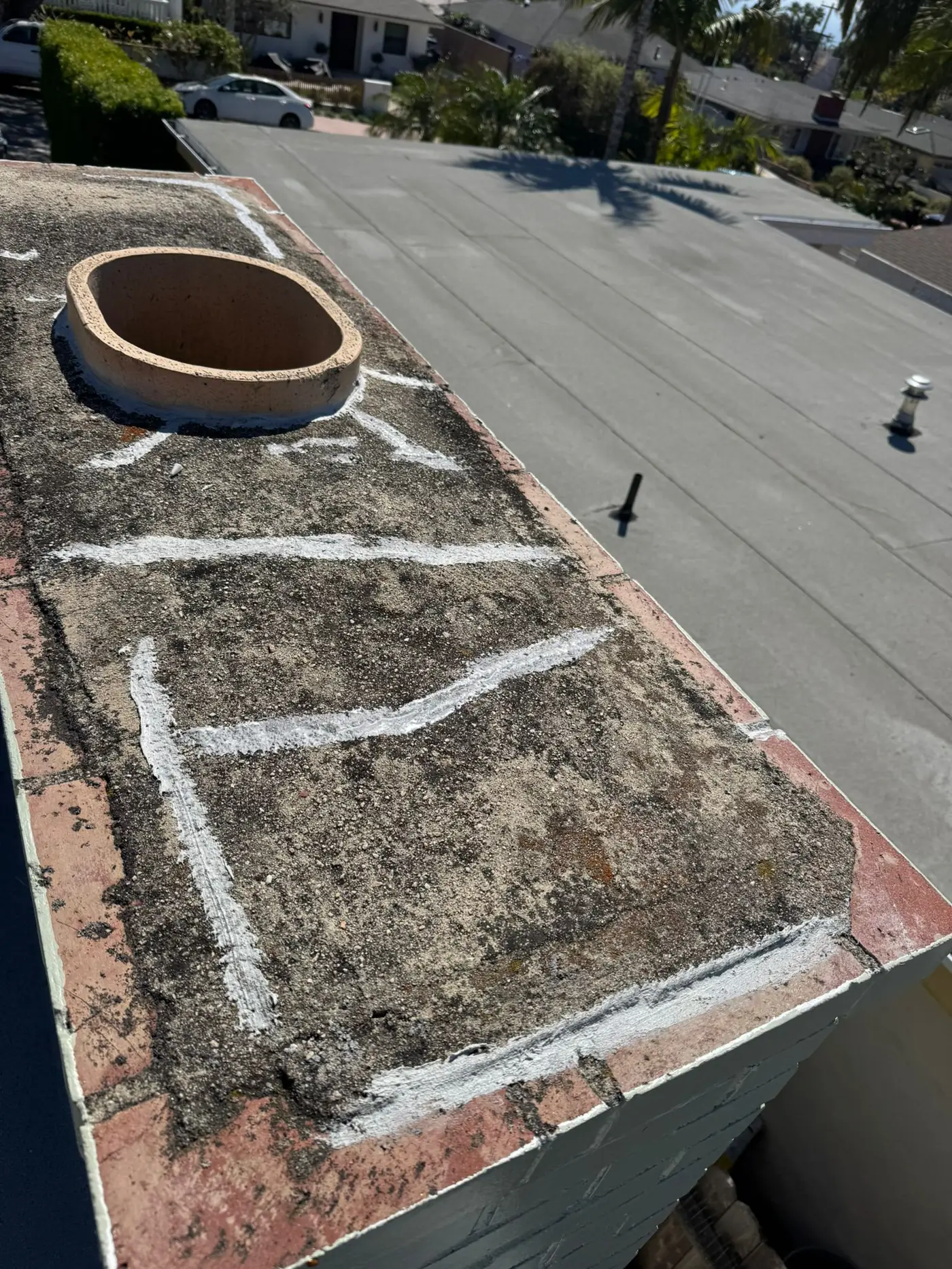
Chimney Tuckpointing & Repointing
Deteriorated mortar joints are ground out to a uniform depth, cleaned of dust, and repacked in thin compacted layers with color-matched mortar — tooled to your chimney's original joint profile so the repair holds up structurally and disappears visually.
- Typical costFrom $500
- Pricing basisFrom $1
- Typical lifespan20–30 years
- StandardBIA Technical Note 46
Tuckpointing vs. Repointing — Clearing Up the Terms
Historically, true "tuckpointing" was a decorative masonry technique: a thin, contrasting tuck line pressed into a wider mortar joint to create the illusion of finer, more precise brickwork than the wall actually had. In modern trade and consumer usage — including on this page — "tuckpointing" and "repointing" mean the same practical thing: grinding out deteriorated mortar and replacing it with fresh material to restore the joint's structural integrity and weather resistance. When Temecula and Orange County homeowners ask us for a "tuckpointing quote," this is the service we're pricing, and it's the service described below.
Mortar is designed to be the sacrificial component of a masonry wall — it's meant to wear before the brick does, because mortar is far cheaper and easier to replace than brick. That's by design, not a flaw, but it means every masonry chimney will eventually need its joints redone. Left unaddressed, failing mortar joints let water track directly into the wall assembly, corrode metal ties and dampers, and — eventually — threaten the structural stability of the entire stack.
Our crews inspect joint depth and condition first, working out how many courses deep the deterioration actually runs before quoting a scope. A chimney with soft, crumbling joints on the weather-facing side but sound mortar elsewhere often only needs partial repointing, while a chimney with widespread erosion needs a full repoint from grade to crown.
The Repointing Process, Step by Step
Old mortar is removed to roughly 2–2.5x the joint width, or a minimum of 3/4 inch, with an angle grinder fitted with a diamond blade sized to the joint. Corners the grinder can't safely reach are hand-raked with a joint chisel to avoid chipping brick edges.
Dust is brushed and rinsed out, since dust left behind prevents proper mortar bond. Brick is lightly dampened — never soaked — so it doesn't wick moisture out of the fresh mortar too quickly, a common cause of weak, crumbly joints in Temecula's dry heat.
New mortar is packed with a narrow pointing or margin trowel in thin layers, never one thick pour, with each layer compacted to eliminate voids that would otherwise trap water or weaken the joint.
The joint is tooled to match the original profile — concave is most common and most weather-resistant — while the mortar is thumbprint-hard. We mist-cure over several days in hot, dry conditions, a step lesser crews skip that's directly responsible for joint longevity here.
Standards We Follow
The Brick Industry Association's Technical Note 46 governs proper mortar selection and joint tooling for repointing work, and it's the reference we build our process around — matching mortar type (typically Type N or Type S, mixed from Portland cement, lime, and sand) to the hardness of the existing brick, since mortar that's harder than the surrounding brick forces the brick itself to absorb stress and crack rather than the joint. The Chimney Safety Institute of America's interest in tuckpointing is more indirect but no less important: sound, watertight mortar joints are one of the primary defenses keeping water from reaching the flue liner and interior framing, which is exactly why CSIA-trained inspectors flag joint erosion during Level 1 and Level 2 inspections.
We use diamond-blade grinders sized between 4.5 and 5 inches to keep cuts precise and avoid over-widening joints, and narrow pointing trowels between 1/8 and 1/4 inch so new mortar goes exactly where it belongs without smearing across the brick face.
Signs You Need Tuckpointing
- • Mortar joints that are visibly recessed, crumbling, or missing — if you can scrape one out with a finger, it needs attention
- • Water stains on ceilings or walls near the chimney chase
- • Efflorescence — white, chalky mineral deposits on the brick face — a direct sign of water moving through the masonry
- • Joint erosion deeper than about 1/4 inch
- • Loose bricks or brick that shifts slightly when pressed
- • A chimney older than 20–30 years that has never had joints redone
Why It Matters More in Temecula & Orange County
Riverside County and Orange County sit within active Southern California seismic zones tied to the San Jacinto, Elsinore, and broader San Andreas fault systems. Masonry chimneys — particularly unreinforced masonry construction common in homes built before modern seismic bracing became standard practice — are among the most seismically vulnerable parts of a house, and mortar joints are the first thing to show stress from ground movement. Sound, well-bonded joints give the whole stack more resilience during minor shaking; deteriorated joints turn small tremors into cracked or dislodged brick.
Temecula's dry heat and intense UV exposure also work against fresh mortar during installation itself — brick that isn't properly dampened first pulls moisture out of new mortar before it can cure correctly, leaving weak, crumbly joints that fail within a few years instead of a few decades. This is exactly why our crews mist-cure every repointing job rather than treating it as a one-and-done application, a step that's easy to skip and hard to notice was skipped until the joints fail early.
Materials & Tools We Use
Mortar isn't one product — it's a family of mixes with different strength and flexibility properties, and using the wrong type is one of the most common causes of premature repointing failure. We mix Portland cement, lime, and sand to match Type N or Type S mortar depending on your chimney's original construction, since mortar that's harder than the surrounding brick forces the brick itself to crack under thermal and seismic stress rather than sacrificing itself the way mortar is designed to. Color is matched with pigmented mortar or mortar dye rather than left to guesswork, so a repointed section doesn't stand out as an obvious patch against decades-old brick.
On the tool side, we grind with 4.5–5 inch diamond blades sized to the joint so cuts stay clean and we're not over-widening joints that were never meant to be that wide. New mortar goes in with narrow pointing and margin trowels between 1/8 and 1/4 inch — wide enough to pack material efficiently, narrow enough to avoid smearing excess mortar across the brick face, which would otherwise require extra cleanup time and risk staining the masonry.
When Repointing Isn't Enough
Tuckpointing repairs the mortar between bricks — it does not repair the bricks themselves. If individual bricks are cracked, spalling, or crumbling from the inside out (a classic sign of freeze-thaw or moisture damage even in a mild climate like ours, since Temecula still sees cold overnight lows in winter), no amount of fresh mortar will fix the underlying problem. Likewise, if an entire section of the chimney is leaning, bulging, or has lost enough structural bond that individual bricks shift when pressed, that's a masonry repair or rebuild issue, not a repointing one.
Part of our job during the initial inspection is telling you honestly which category your chimney falls into. We'd rather quote a smaller repointing job that solves the actual problem than sell a bigger scope you don't need — and conversely, we'll tell you plainly if what looks like "just some bad joints" is actually a sign of deeper structural movement that calls for full masonry repair or, in more serious cases, chimney rebuilding from the flashing line up.
Protecting Your Roof & Landscaping During the Job
Grinding out old mortar produces a fair amount of dust and debris, so before work starts we lay drop cloths and tarps around the base of the chimney and along the roofline access path to catch falling material. Roof jacks, standoffs, and fall-protection harnesses are used on any pitch steep enough to need them — common on Temecula and Orange County tile roofs — so our crew can work safely without dragging ladders or equipment across roof tile in a way that risks cracking it. We clean up thoroughly at the end of every job, including brushing excess mortar dust off the brick face and hauling away debris, so the only difference you notice afterward is a chimney with sound, weathertight joints.
Tuckpointing Cost in Temecula
Most tuckpointing projects run $500–$2,500, or roughly $1–$5 per linear foot ($8–$30 per square foot) depending on deterioration depth and how much color-matching precision the job requires. Scaffolding adds $200–$600 when a ladder alone doesn't provide safe access to a tall or steep-roof chimney. The biggest price drivers are total joint linear footage, how deep the deterioration runs, chimney height and roof pitch, and how closely the new mortar needs to match existing color. A small, single-story chase with light erosion on one face lands at the low end of that range, while a two-story chimney needing a full repoint on all four sides, with steep tile roof access and precise color-matching, lands toward the top. We always provide a written, itemized quote before starting so there are no surprises once grinding begins. For a full breakdown of pricing across every chimney service, see our complete chimney service cost guide.
Frequently Asked Questions
Is tuckpointing the same thing as repointing?+
In modern trade and consumer usage, yes — both refer to grinding out deteriorated mortar and replacing it. Historically, true tuckpointing was decorative, using a thin contrasting tuck line in a wider joint, but the terms are used interchangeably today.
How deep do you grind out the old mortar?+
Roughly 2 to 2.5 times the joint width, or a minimum of 3/4 inch, with a diamond-blade angle grinder. Corners are hand-raked with a joint chisel to avoid chipping brick edges.
How long does tuckpointing last?+
Typically 20 to 30 years, sooner in high-moisture areas or if the original mortar hardness was mismatched to the brick. Temecula's dry heat can shorten that window if joints weren't properly mist-cured during installation.
How do I know if my chimney needs tuckpointing?+
Look for recessed, crumbling, or missing mortar; water stains near the chimney chase; efflorescence on the brick face; and joint erosion deeper than about 1/4 inch.
Why does mortar joint color matter?+
Mismatched color is one of the most common signs of a rushed repointing job. We color-match new mortar using pigmented mortar or dye so repairs blend in rather than creating an obvious patchwork.
How much does chimney tuckpointing cost in Temecula?+
Most projects run $500–$2,500, or $1–$5 per linear foot, depending on deterioration depth. See our cost guide for a full breakdown.
Related Services
Ready to Book Your Tuckpointing?
Free written estimates for Temecula, Murrieta, Menifee, Wildomar, Winchester, French Valley and Orange County.