
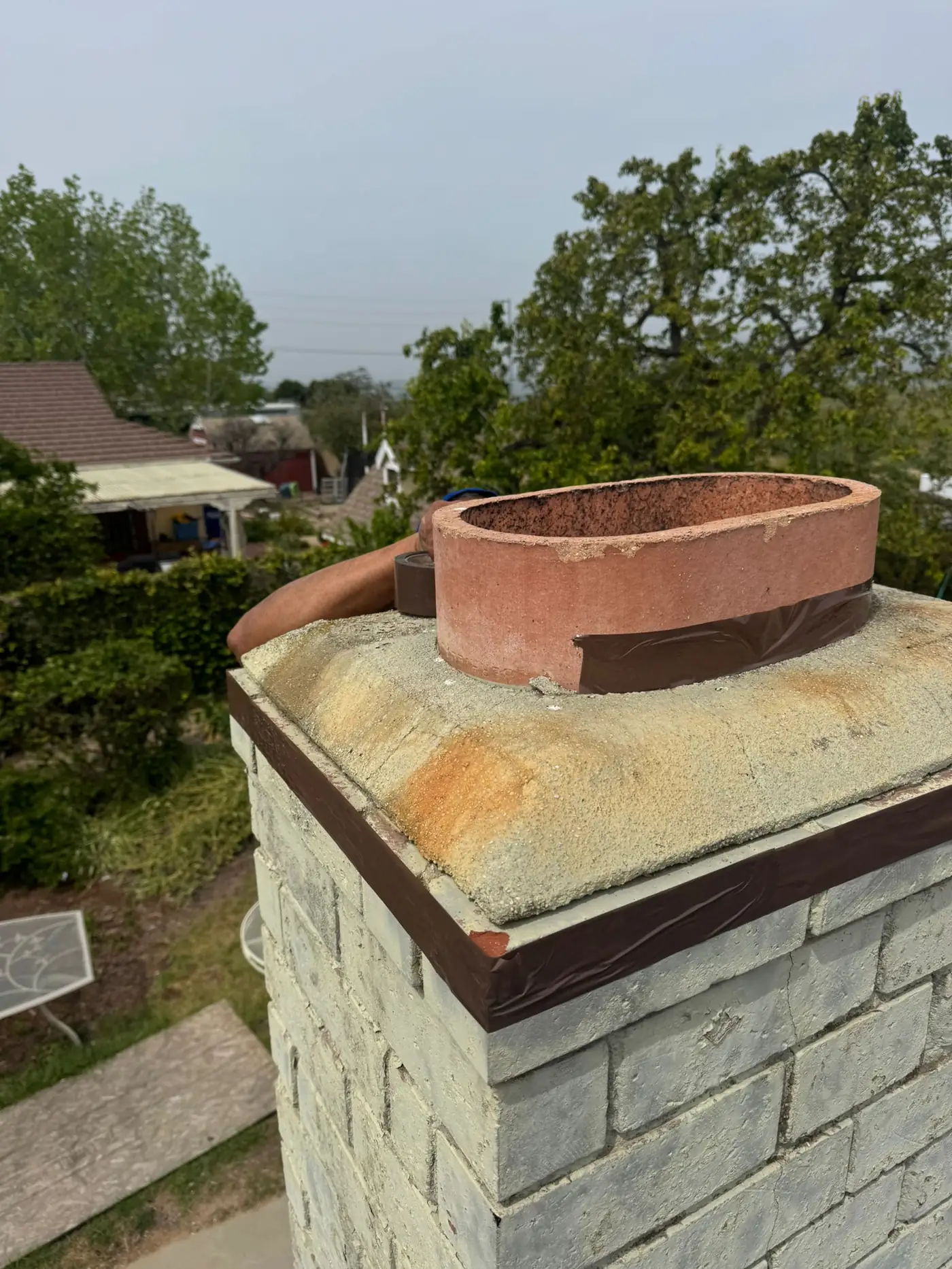
Chimney Masonry Repair
Brick and mortar repair with materials matched to your chimney's age and hardness — not just whatever's on the truck — so the fix holds and blends in, rather than becoming next season's callback.
- Typical costFrom $500
- Mortar cure time28 days min.
- Condition checkEvery 3–5 yrs (20yr+)
- StandardBIA / CSIA
What Masonry Repair Involves
We start every masonry repair by assessing the type of deterioration — surface spalling limited to the outer brick face, structural cracking or shifting that suggests movement, or full section failure where an entire course of brick has come loose. That assessment determines the whole scope of the job, since a surface spalling fix and a structural section rebuild are completely different levels of work even though they can look similar from the ground.
Deteriorated or loose brick is removed carefully with a masonry chisel and hammer, or a grinder for tougher joints, without disturbing sound adjacent brick — a sloppy removal process is one of the fastest ways to turn a small repair into a much larger one. Once the cavity is open, we clean it out and inspect for a water path or corroded metal ties and anchors, which is extremely common on older unreinforced masonry chimneys where the original steel connectors have been rusting quietly for decades.
Replacement brick is set matched for size, color, and texture, with fresh mortar in a joint width and bond pattern consistent with the rest of the chimney — running bond is the most common pattern on residential chimneys in this area. We tool the new joints to match the existing profile, whether that's concave, flush, or weathered, so the repair reads as seamless rather than as an obvious patch. Fresh mortar needs a minimum of 28 days to fully cure before any sealant goes on, though some water-repellent products are rated for application sooner per manufacturer spec — we follow whatever the specific product calls for.
Why Mortar Hardness Has to Match the Brick
Pre-1930s chimneys were commonly built with soft, lime-based mortar designed to flex and wear before the brick itself did.
Standard Portland-cement mortar used carelessly on a historic chimney becomes harder than the surrounding brick — the opposite of how the original system was designed to work.
When mortar is harder than brick, moisture and thermal movement stress get pushed into the brick itself, causing it to spall and crack — mortar should always be equal to or softer than the brick it's protecting, never harder.
Standards We Follow
The Brick Industry Association's technical notes guide our mortar selection and tuckpointing approach on every job, particularly around matching mortar type to brick age and load requirements. CSIA addresses masonry work specifically around fire safety and structural clearance — making sure any repair maintains the correct clearance to combustibles and doesn't compromise the flue's fire-safe performance.
In California, structural repairs on unreinforced masonry chimneys can trigger California Building Code seismic retrofit considerations, which is particularly relevant for pre-1980s homes across Temecula and the wider region. Post-Northridge-earthquake code awareness treats unreinforced masonry chimneys as a known seismic vulnerability, so when a repair scope crosses into structural territory, we evaluate it against current seismic guidance rather than just matching what was there before.
Signs You Need Masonry Repair
- • Cracked, chipped, or spalling brick faces
- • Missing brick chunks or visibly deteriorated corners
- • Leaning or bulging sections of the chimney stack
- • Loose bricks you can wiggle by hand
- • A gap opening up between the chimney and the house wall — can mean the chimney is pulling away, common post-seismic
- • Rust stains bleeding from mortar joints, indicating corroding metal ties beneath the surface
Why Masonry Repair Is a Bigger Deal in Riverside & Orange County
Riverside County and Orange County sit within active Southern California seismic zones tied to the San Jacinto, Elsinore, and broader San Andreas fault systems. Masonry chimneys — especially unreinforced masonry chimneys common in homes built before modern seismic bracing became standard, roughly pre-1990s in the wake of Northridge-earthquake code awareness — are among the most seismically vulnerable parts of a house. They're tall, heavy, and rigid compared to the lighter wood-frame structure they're attached to, which means they respond to ground shaking very differently than the rest of the house does.
Cracked flue tiles, separated crown sections, and chimney-to-roofline gaps are common post-earthquake findings, and they're frequently invisible from the ground. On the masonry side specifically, we look for hairline cracking that runs through multiple mortar joints in a line — a pattern that usually means the whole section shifted together rather than individual joints simply aging — since that pattern calls for structural tie reinforcement, not just a cosmetic repoint.
Materials & Frequency
We use Type N mortar — general purpose, around 750 psi — for most residential repointing, and Type S mortar — around 1,800 psi — for structural work where higher strength is required. Removal is done with diamond-blade grinders and mortar-raking tools that clean out old joints precisely without over-cutting into the surrounding brick, and where ties have failed, we install brick ties or corrugated metal anchors to structurally reattach sections rather than relying on mortar alone to hold them.
Masonry repair itself is typically as-needed, driven by what an inspection finds rather than a fixed calendar. That said, a full masonry condition assessment is a reasonable investment every 3 to 5 years for chimneys over 20 years old, or for any chimney in a seismic or freeze-thaw prone area — catching a small section of deteriorating mortar during a scheduled check is far cheaper than discovering a structural issue after it's progressed.
Repointing vs. Full Section Replacement
Not every masonry job requires pulling brick. When the brick units themselves are still sound but the mortar joints have eroded, cracked, or washed out, repointing — removing the failed mortar to a consistent depth and packing fresh mortar back in, matched in color and tooled to profile — is the correct, less invasive fix. This is a narrower scope than full masonry repair and is covered in more depth on our dedicated tuckpointing page, but it's worth understanding the distinction: repointing addresses the joints, masonry repair addresses the brick units themselves.
Full section replacement becomes necessary when an entire course or corner has failed together — usually the result of long-term water intrusion that's undermined multiple courses at once, or a structural shift that's cracked brick across a wide area rather than in isolated spots. We'll always explain which category your chimney falls into before starting work, since the cost and timeline between a repoint and a section rebuild can differ by a factor of five or more, and homeowners deserve to know which one they're actually paying for.
Matching Historic Brick
Older homes across Temecula's historic core and surrounding rural properties sometimes have brick styles that simply aren't manufactured anymore — different dimensions, different clay color, different surface texture than what's sold at a standard supply yard today. When we can't source an exact match, we look at reclaimed brick suppliers first, since a salvaged brick from the same era is almost always a closer match than a new brick trying to imitate an old color. When even that isn't available, we select the closest modern equivalent and place it in a less visible course or location where possible, so the overall appearance of the chimney stays as consistent as we can reasonably make it.
Is It Masonry, or Something Else?
If the deterioration is limited to mortar joints without brick loss, tuckpointing may be all that's needed. If water is entering through the top of the stack rather than the brick face itself, check our crown repair page — fixing the water source first is always step one.
What Happens If Corroded Ties Go Unaddressed
Metal ties and anchors embedded in the masonry are what actually hold a chimney wythe connected to itself and, on some older construction, to the house framing. When water reaches those ties, they rust, and rust expands — a phenomenon masons sometimes call "rust jacking," where the expanding corroded metal physically pushes surrounding brick and mortar apart from the inside. This is one of the more deceptive failure modes we deal with, because the exterior can look only mildly cracked while the internal tie system has already failed structurally. It's also exactly why we inspect the cavity behind any brick we remove rather than just replacing what's visible and moving on — a repair that ignores a failed tie system will need to be redone within a couple of years once the corrosion resumes its work.
Chimney Masonry Repair Cost in Temecula
Masonry repair typically runs $500–$3,000+ depending on brick-unit count and access. The biggest price drivers are how many bricks need replacing, how difficult it is to match the original brick's color and texture (older or discontinued brick styles cost more to source or fabricate a match for), chimney height and roof pitch, and whether structural tie reinforcement is needed on top of the visible brick work.
For a full breakdown of every chimney service and what drives price up or down, see our complete chimney service cost guide.
Frequently Asked Questions
What does chimney masonry repair actually involve?+
Assessing the deterioration type, removing deteriorated brick without disturbing sound brick, inspecting for corroded ties, and setting matched replacement brick with fresh mortar tooled to match the existing joint profile.
Why does mortar hardness matter on an older chimney?+
Older chimneys often used soft lime-based mortar. Modern Portland-cement mortar can become harder than the brick, causing the brick itself to spall. Mortar should always be softer than or equal to the brick, never harder.
What are the warning signs I need masonry repair?+
Cracked or spalling brick faces, missing brick, leaning or bulging sections, loose bricks, gaps between the chimney and house wall, and rust stains bleeding from mortar joints.
How often should older chimneys get a masonry condition check?+
Every 3 to 5 years for chimneys over 20 years old, or in seismic or freeze-thaw prone areas, in addition to the standard annual Level 1 inspection.
How much does chimney masonry repair cost in Temecula?+
Typically $500–$3,000+ depending on brick count, color/texture match difficulty, height, and whether structural tie reinforcement is needed. See our cost guide for details.
Is a gap between my chimney and house wall serious?+
Yes — it can mean the chimney is pulling away from the structure, a serious issue commonly seen after seismic activity, and warrants a prompt inspection rather than being treated as routine settling.
Related Services
Ready to Get Your Masonry Repaired?
Free written estimates for Temecula, Murrieta, Menifee, Wildomar, Winchester, French Valley and Orange County.